The jobs number that October's headline hid
Employment was flat in October. Underneath, private employers cut 53,000 jobs and public hiring filled the gap.
Statistics Canada’s October Labour Force Survey looked calm at first glance. Employment was essentially unchanged, down 4,700, and the unemployment rate rose 0.2 points to 6.7% (Statistics Canada).
Flat is not the same as stable. Two big moves cancelled each other out.
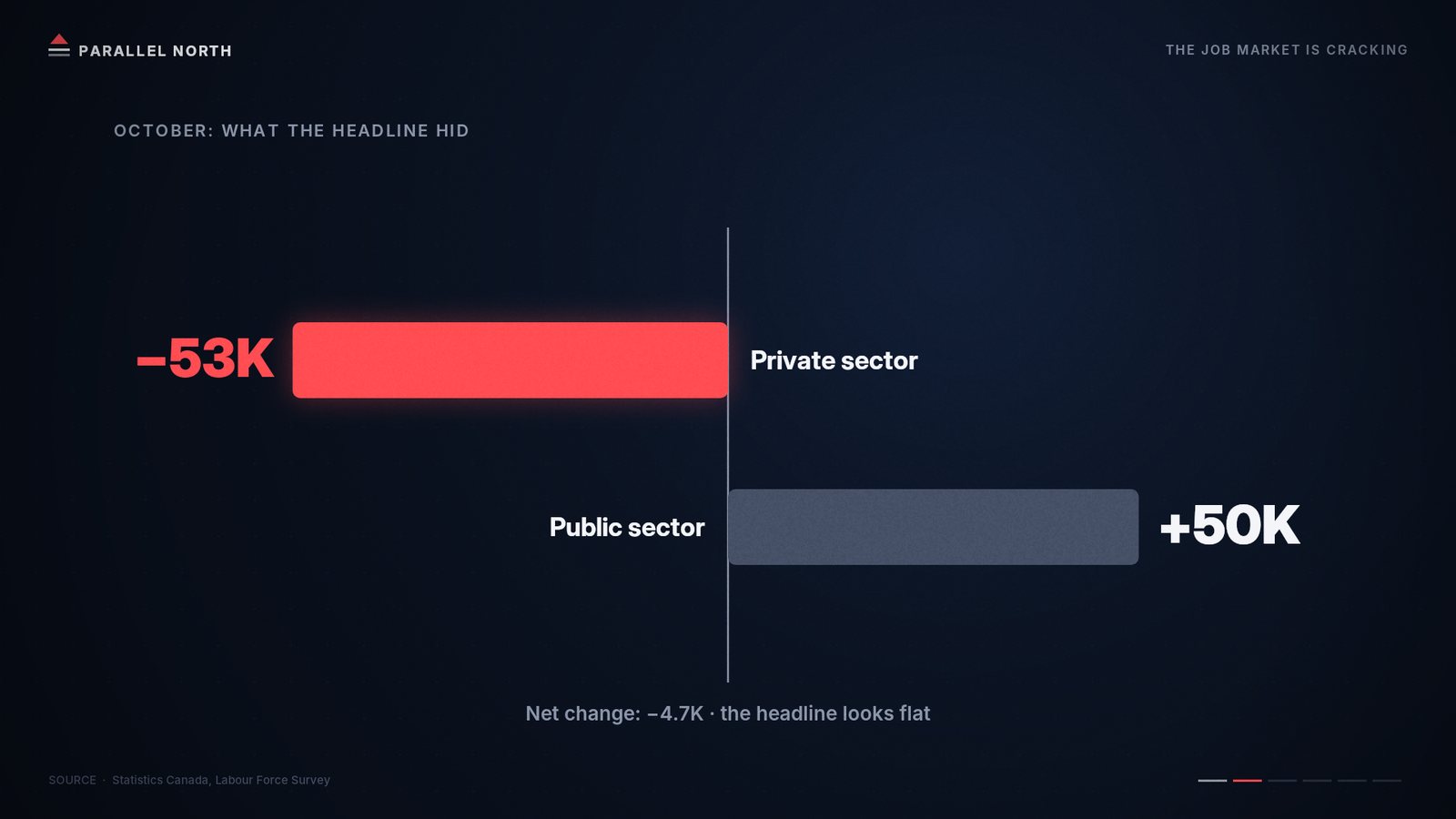
Private down, public up
The number of private-sector employees fell by 53,000 in October, a 0.4% drop and the first decline since February. Public-sector employment rose by 50,000 in the same month.
The public-sector gain looks more like a rebound than a trend. Over the past twelve months, public-sector employment is still down 70,000, while the private sector is up 35,000. But for the month, the private economy, the part most sensitive to interest rates, went backwards.
Who’s feeling it
- Young workers. Unemployment for 15- to 24-year-olds rose 0.7 points to 13.7%.
- The long-term unemployed. 23.7% of the 1.5 million unemployed have been looking for 27 weeks or more, up from 21.5% a year ago.
- Alberta. The province lost 24,000 jobs, and its unemployment rate jumped 0.9 points to 7.3%, even with oil prices high for most of the year. Ontario’s rate also reached 7.3%.
- Retail and wholesale. Wholesale and retail trade shed 29,000 jobs in October.
Why it matters now
The Bank of Canada raised its policy rate to 2.5% on October 28, its first increase since 2023, to keep high energy prices from spreading into broader inflation (Bank of Canada). Higher rates work mainly by slowing private borrowing, hiring and spending. October’s report suggests that part of the economy was already slowing before the hike had time to bite.
The next Labour Force Survey, for November, comes out on December 4. That’s five days before the Bank’s next decision on December 9 (Statistics Canada release calendar).
We go deeper on this in Episode 1, out Saturday.