Is Canada repeating Europe's 2011 mistake?
The Bank of Canada raised rates into a weakening job market to stop an oil shock from spreading. The last central bank that tried this reversed course within months.
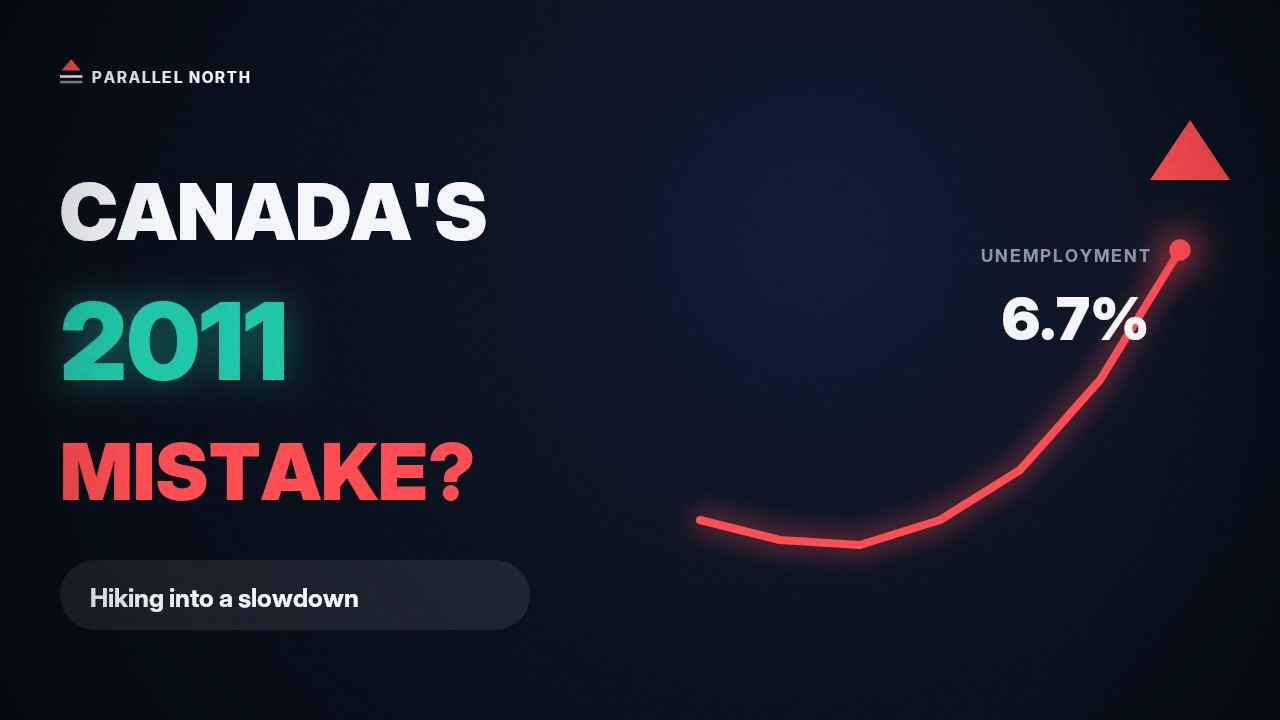
On October 28, the Bank of Canada raised its policy rate by a quarter point to 2.5%. It was the Bank’s first increase since July 2023 (Bank of Canada).
Nine days later, Statistics Canada reported that unemployment had climbed to 6.7% and that private employers had cut 53,000 jobs in a single month (Statistics Canada).
Central banks normally raise rates to cool an economy that’s running hot. Canada’s isn’t. This week’s episode asks why the Bank is tightening into a slowdown, and what history says about how that tends to end.
Why the Bank hiked: oil, not demand
The shock started in the Strait of Hormuz. When the waterway was effectively shut this spring, Brent crude spiked to around $118 a barrel in late March (Wikipedia: 2026 Iran war fuel crisis). Renewed attacks on shipping pushed it back to $110 in mid-October (CNBC).
That energy shock lifted Canadian CPI inflation to 3.1% in September (Wealth Professional, reporting Statistics Canada). Underneath, the Bank’s preferred core measures were near 1.9% and 2.0%, right around the 2% target (Trading Economics).
So the worry is not a hot economy. It’s that expensive fuel starts leaking into everything else. Governor Tiff Macklem put it plainly to the Senate banking committee on November 5:
“The prices of gasoline, diesel and heating oil are elevated and are expected to remain higher for longer.”
In the same statement he said CPI inflation is expected to rise to about 3½% by year-end, and that “there could be a need to raise the policy rate further, but given the uncertainties, we will proceed carefully” (Bank of Canada).
The Bank is buying that insurance while its own October forecast puts 2026 growth at only about 1% (StockWireX summary of the Monetary Policy Report; secondary summary).
What the jobs data actually shows
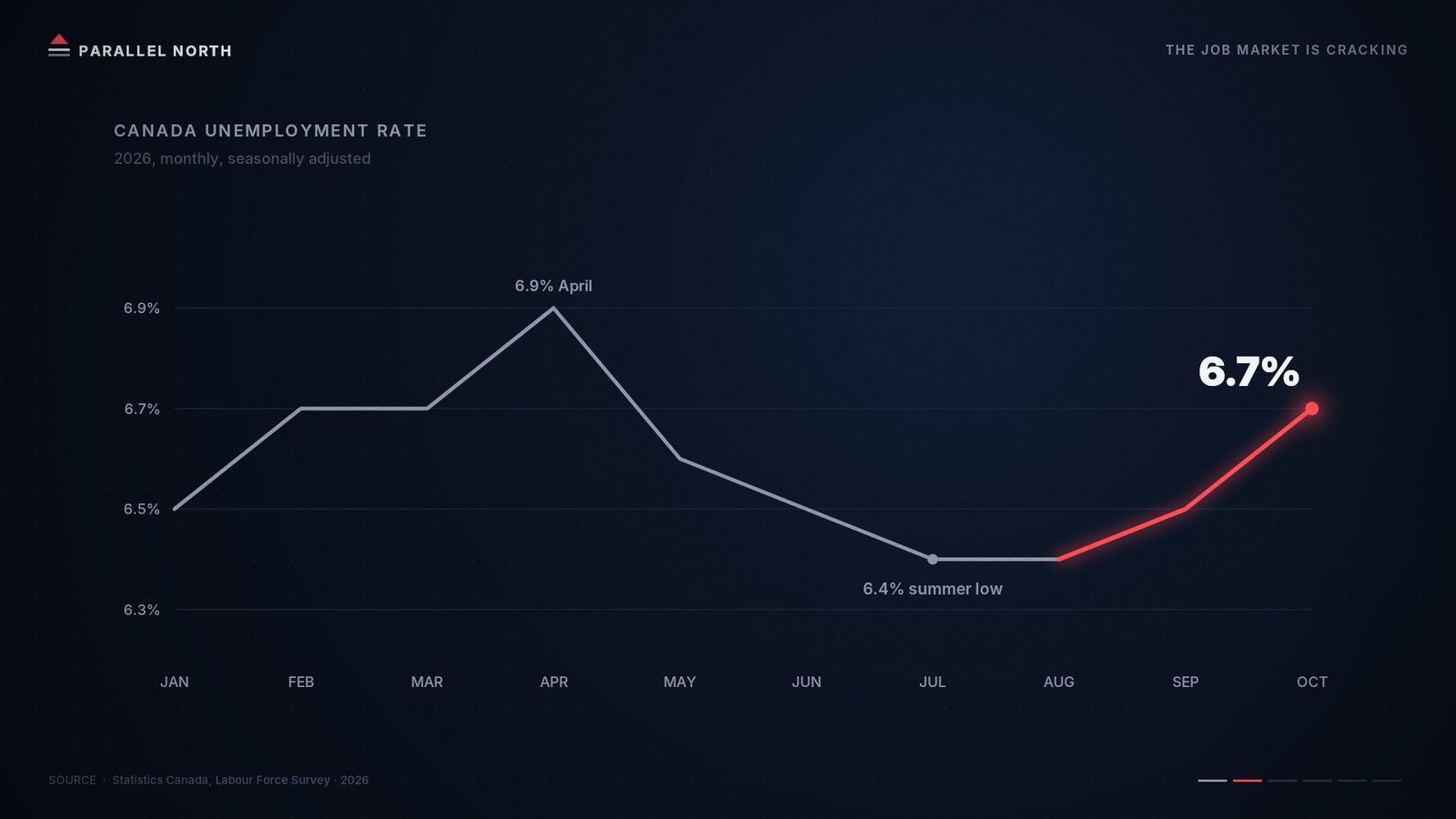
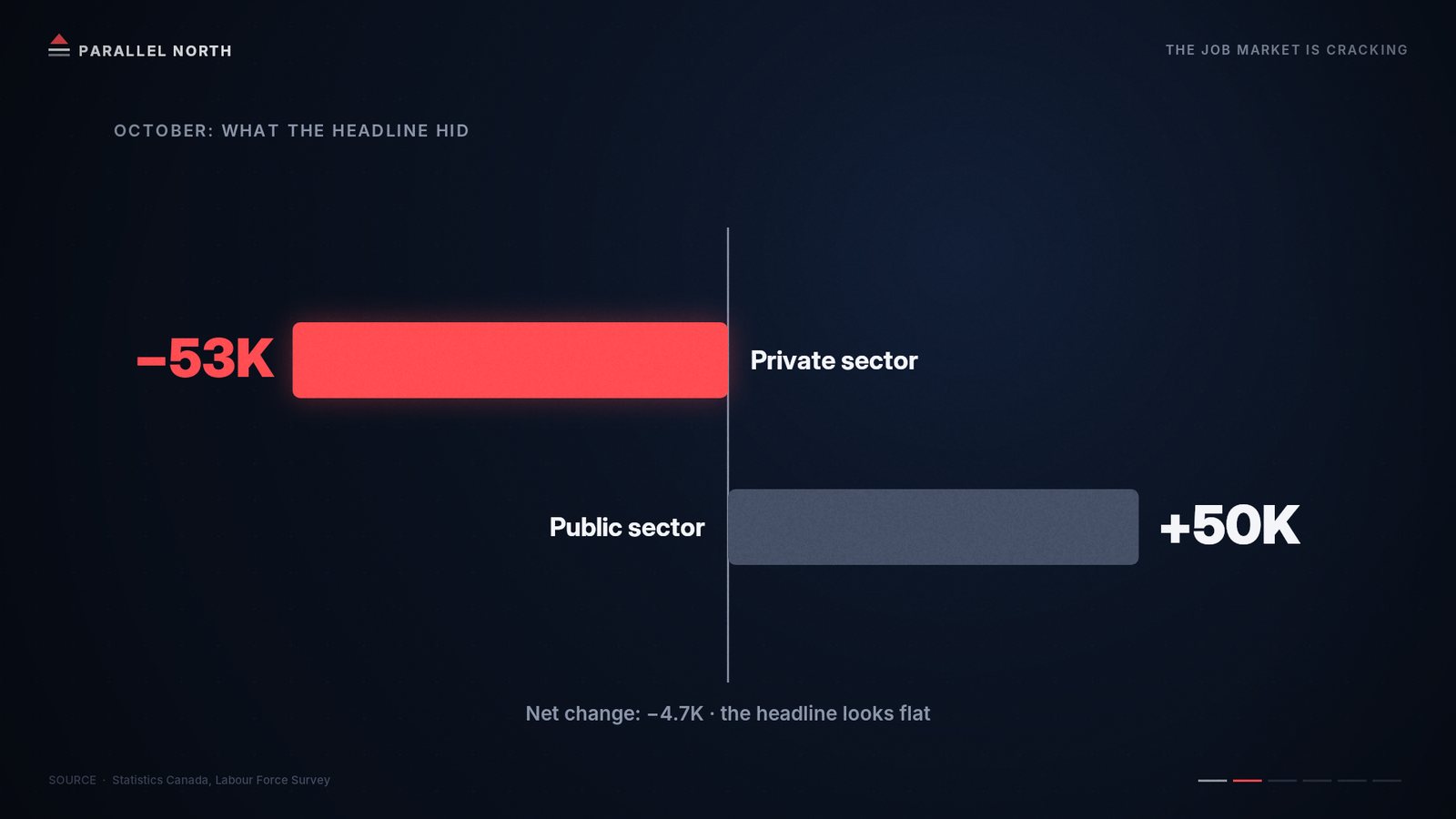
October’s Labour Force Survey showed employment essentially flat, down 4,700, after losses of 68,000 in September and 42,000 in August. Unemployment rose 0.2 points to 6.7%, its second straight increase (Statistics Canada). The details are weaker than the headline:
- Private-sector employees fell 53,000, the first drop since February. A 50,000 rise in public-sector jobs covered it up.
- Youth unemployment rose 0.7 points to 13.7%.
- 23.7% of the unemployed have been looking for 27 weeks or more, up from 21.5% a year earlier.
- Alberta lost 24,000 jobs, and its unemployment rate jumped 0.9 points to 7.3%, even with oil expensive. Ontario is at 7.3% too.
The squeeze
Average hourly wages were up 2.2% from a year earlier in October. Prices were up 3.1% in September. Paycheques are losing ground. Statistics Canada also found that 29.7% of Canadians live in households struggling to meet basic needs such as food, housing and transportation, up from 27.7% a year earlier (Statistics Canada).
Housing is feeling it. The Canadian Real Estate Association has cut its 2026 sales forecast for the third quarter in a row and now expects home sales to fall 5.2% this year (CREA).
Stocks tell a different story. The S&P/TSX Composite is up about 18% over the past year and sits within 2% of its August record of 37,069 (Trading Economics). The market is pricing a soft landing that the labour data hasn’t confirmed.
The view from the south
The Federal Reserve held its target range at 3.75% to 4.00% on October 28, but two officials voted to hike (Admiral Markets). Since then, October payrolls rose 165,000 against a 65,000 forecast (IndustryWeek), and core CPI rose 0.3% for a third straight month (BLS). Three months at that pace annualizes to roughly 3.7%.
Fed Governor Christopher Waller had said a print like that should put a half-point December hike on the table (MLQ). After the CPI release, futures markets priced a December hike as the most likely outcome (Investing.com, citing CME FedWatch).
Why Canadians should care: if the Fed tightens faster than the Bank of Canada, the rate gap tends to favour the US dollar. That can weigh on the loonie and raise the price of what Canada imports.
The 2011 parallel
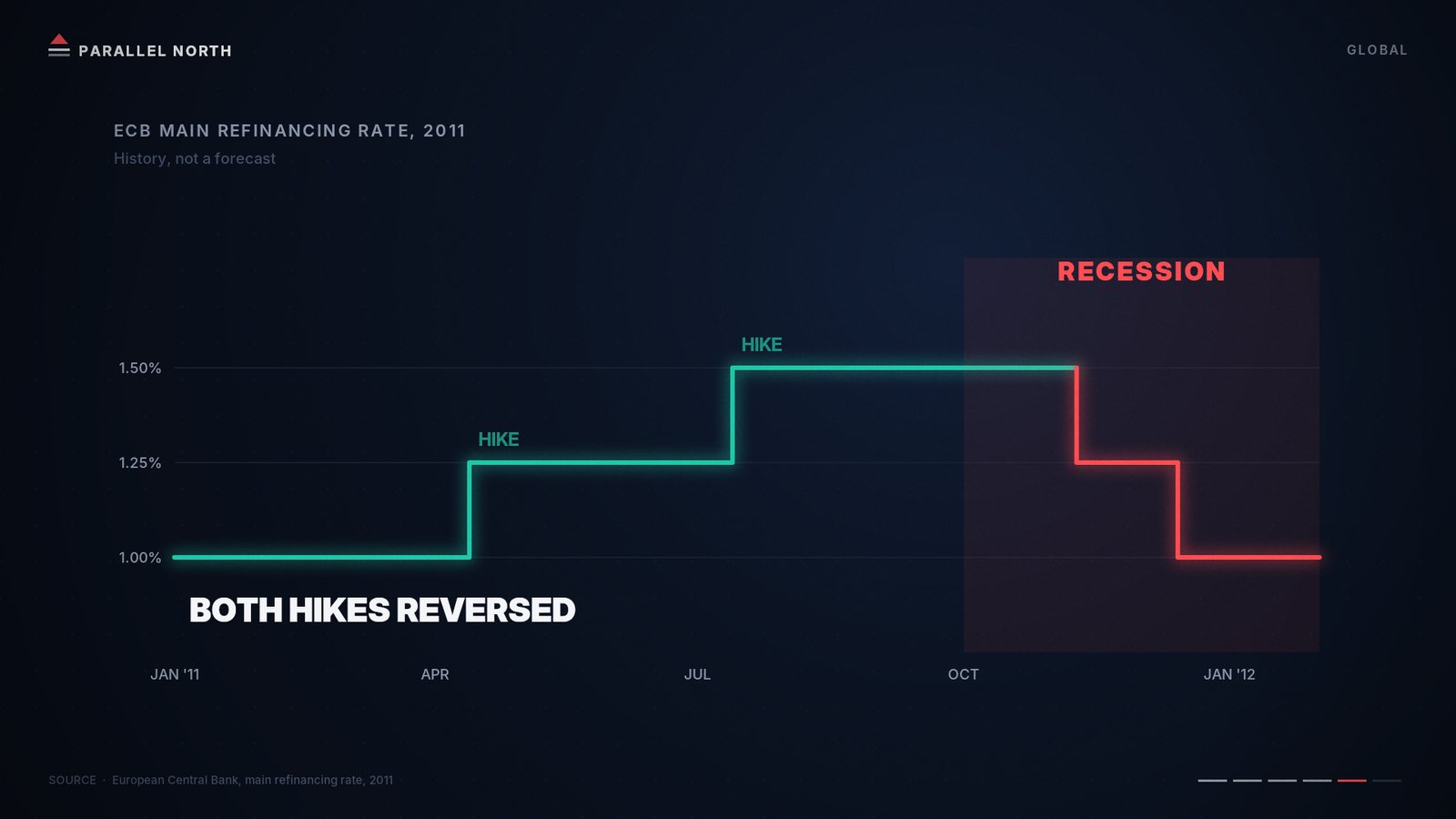
Europe has been here before. In 2011, with oil climbing, the European Central Bank raised its main rate from 1% to 1.25% in April and to 1.5% in July, to head off energy-driven inflation. By November the euro area was sliding back into recession. The ECB cut in November and again in December, reversing both hikes before the year was out (European Central Bank chronology).
That doesn’t mean Canada is headed for the same outcome. Every cycle is different. But it is the textbook case of a central bank hiking into a supply shock while the economy underneath was already weakening.
Today, the ECB is again leaning the same way: it held its deposit rate at 2.5% on October 29 with euro-area inflation near 3.8%, and said it had debated a hike (Babypips).
The chart that decides December
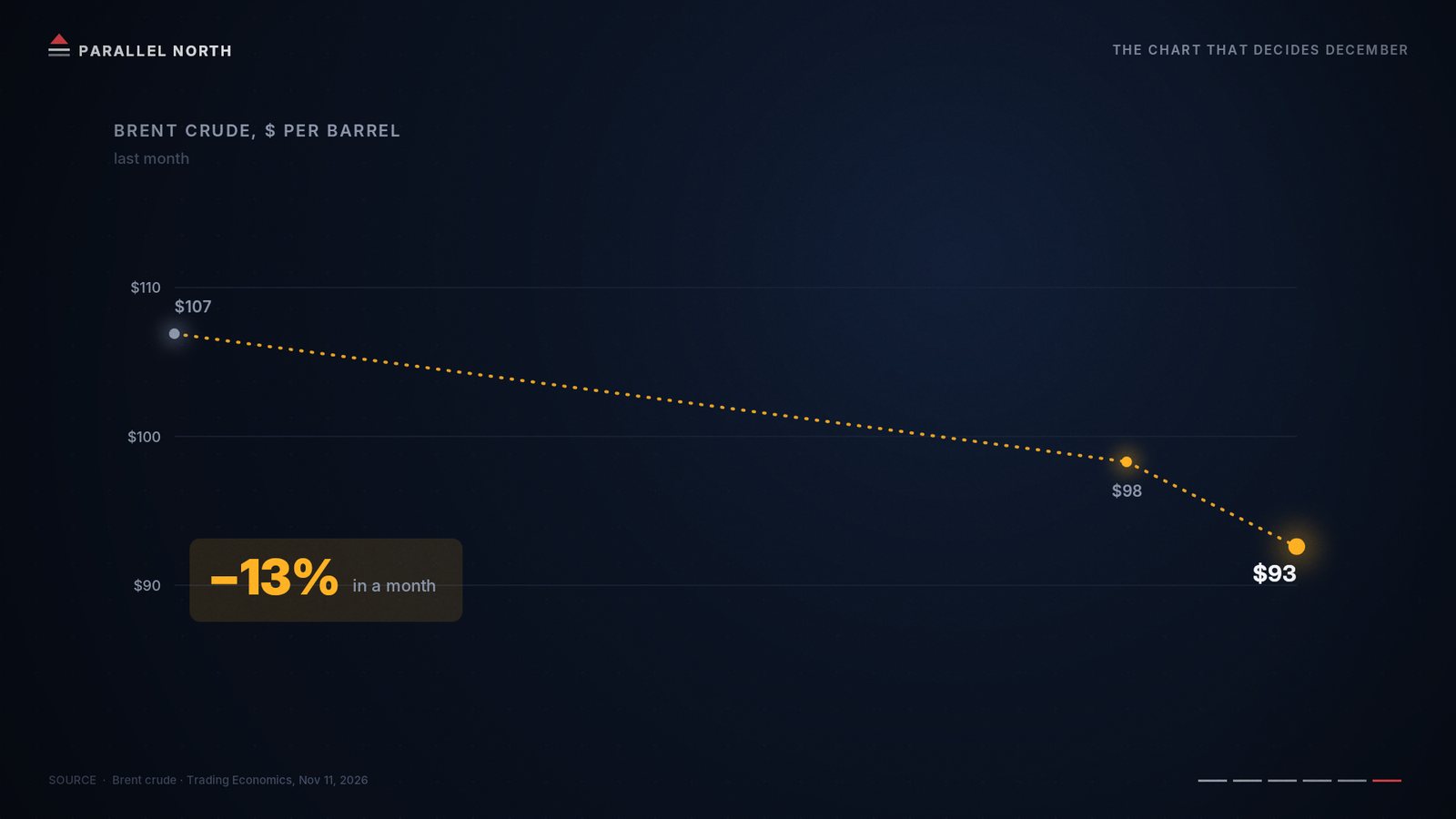
Oil has cracked. Brent slid to a ten-week low this week and was near $92.60 on November 11, down about 13% in a month (Trading Economics).
Two scenarios follow from that:
- If oil keeps falling, the reason for this tightening starts to fade, and the Bank can pause.
- If oil climbs back above $100, the Bank may feel forced to hike again, straight into a weakening job market.
What to watch
| Date | Release | Why it matters |
|---|---|---|
| Nov 16 | Canada CPI, October | First inflation reading since the hike |
| Nov 30 | Canada GDP, third quarter | Whether growth is holding up |
| Dec 4 | Canada Labour Force Survey, November | A third rise in unemployment would argue for a pause |
| Dec 9 | Bank of Canada and Federal Reserve decisions | Both land on the same day |
| Dec 10 | US CPI, November | Annual inflation rates return to the report |
Release dates: Statistics Canada release calendar, BLS schedule.
The Bank of Canada is betting it can stop an energy shock from becoming a lasting inflation problem. The job market is signalling it can’t afford another hike. Over the next four weeks, we find out which one gives first.